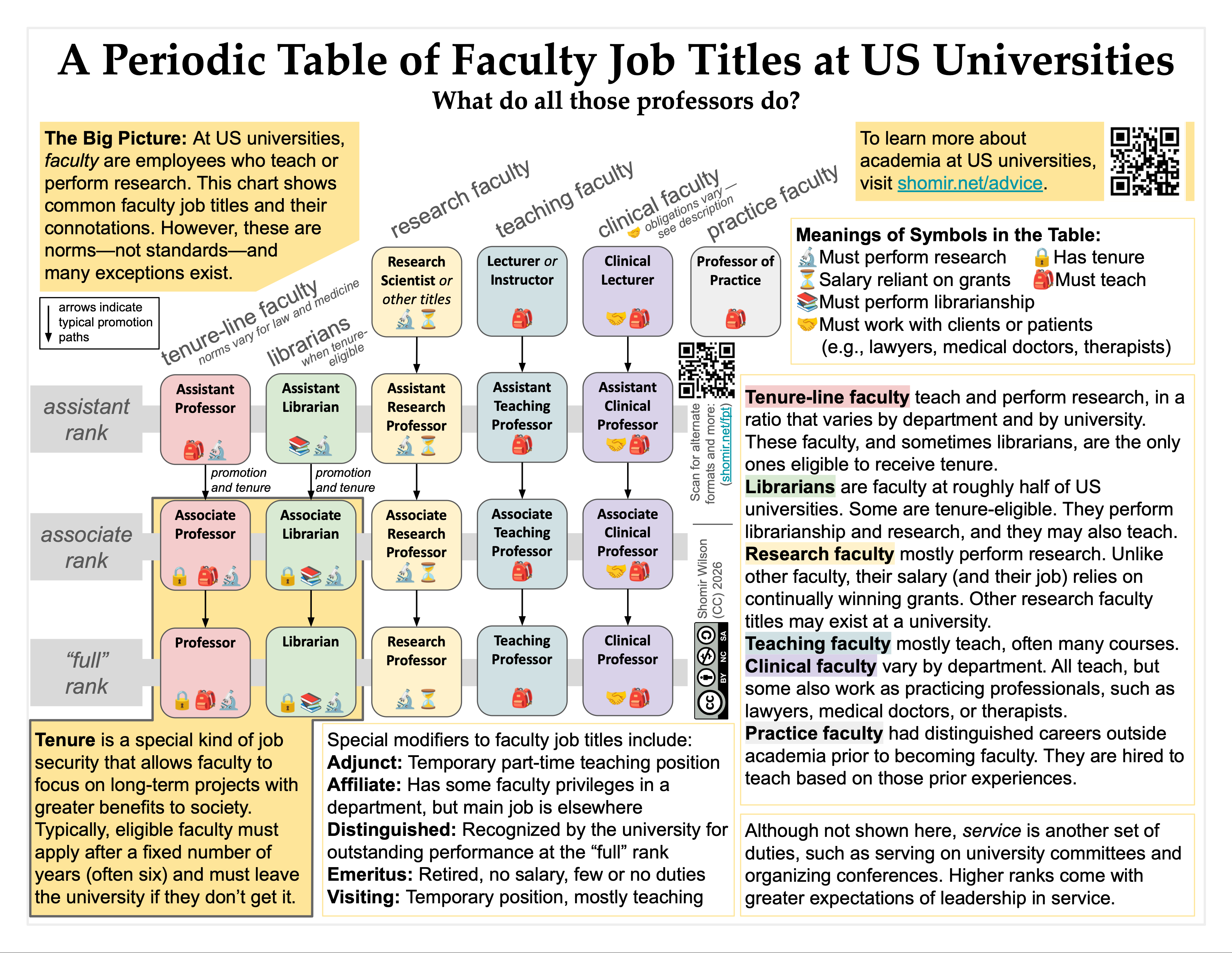
A Periodic Table of Faculty Job Titles at US Universities
You can download the diagram below as a PDF in landscape orientation (for reading onscreen) or in portrait orientation (slightly easier to print).
Questions and Answers
- Is this diagram correct for my university?
- I thought all professors (or all faculty) teach. Some don't?
- I want to talk with a faculty member about research. Whom do I contact?
- How do I address a faculty member, like in the salutation line in an email?
- Do people ever move between these lines?
- What impact does promotion have?
- I know someone aspiring to be faculty. Why don't they just work at a nearby university?
- Why did you make this diagram?
- What does the CC rectangle mean?
Is this diagram correct for my university?
I didn't create it for any one university, and it generally reflects norms at large universities in the US where lots of faculty are engaged in research, called "R1" universities. Variations exist in the details. Other kinds of universities may have fewer faculty types, reflecting a greater focus on teaching.
The tenure-line faculty titles exist at nearly all US universities, although in a few places tenure isn't granted.
I thought all professors (or all faculty) teach. Some don't?
Teaching loads vary widely: by faculty type, by department, and by university. Some faculty almost exclusively teach, some balance teaching with other duties, and some don't teach at all. As the diagram shows, faculty at a large university can have many different responsibilities.
I want to talk with a faculty member about research. Whom do I contact?
Any faculty member might be involved in research, although as the diagram shows, some are more likely than others. You can search for a faculty member's publications to see what topics they can speak with you about. Within computing and information sciences, many faculty also have independent websites (i.e., not just the simple pages created for them by their department), and you should check those too.
How do I address a faculty member, like in the salutation line of an email?
I cover this in the Guide for Interacting With Faculty.
Do people ever move between these lines?
Yes. In particular, research faculty often must change lines after a few years or leave academia, because it's difficult to win grants as consistently as they must to retain their jobs. (In contrast, faculty in other kinds of positions benefit from winning grants but aren't as reliant upon them.) A few research faculty find special arrangements to stay indefinitely, but that's relatively rare.
Faculty sometimes transfer into tenure-line positions, for the stability possible through tenure and the balance of responsibilities. However, tenure-line faculty positions are especially difficult to get. (You can read my guide for getting a tenure-line position or about my long road to a tenure-line position.) Also, nearly anyone who seeks a tenure-line position must start at assistant professor and spend time in that rank to earn promotion and tenure.
On rare occasions tenure-line faculty transfer into teaching-line positions, if they discover the majority focus on teaching is a better fit for them than the divided focus between research and teaching.
What impact does promotion have?
Senior faculty receive greater pay, and they are expected to take on greater responsibilities, especially involving leadership. Within the university, they become eligible for activities like running research centers or chairing certain committees. Some become administrators, who manage faculty or help to chart the direction of the university. In their professional organizations, senior faculty often take on bigger leadership roles.
I know someone aspiring to be faculty. Why don't they just work at a nearby university?
Faculty jobs openings tend to be highly competitive. (I submitted 198 faculty applications over four years before I received my first offer.) It's also possible that the person wants to work at a different type of university than the nearby ones. Working at a small liberal arts college, for example, is very different from working at an R1. Moving across the country for a faculty position isn't uncommon, and some people move internationally.
Why did you make this diagram?
I enjoy explaining academia, and I remember being a student who wanted to know more about these distinctions. I made it to help people understand the breadth of responsibilities that different kinds of faculty have.
What does the CC rectangle mean?
It means the diagram is offered with a Creative Commons license. More specifically, I offer the infographic under a Creative Commons Attribution-NonCommercial-ShareAlike 4.0 International license.